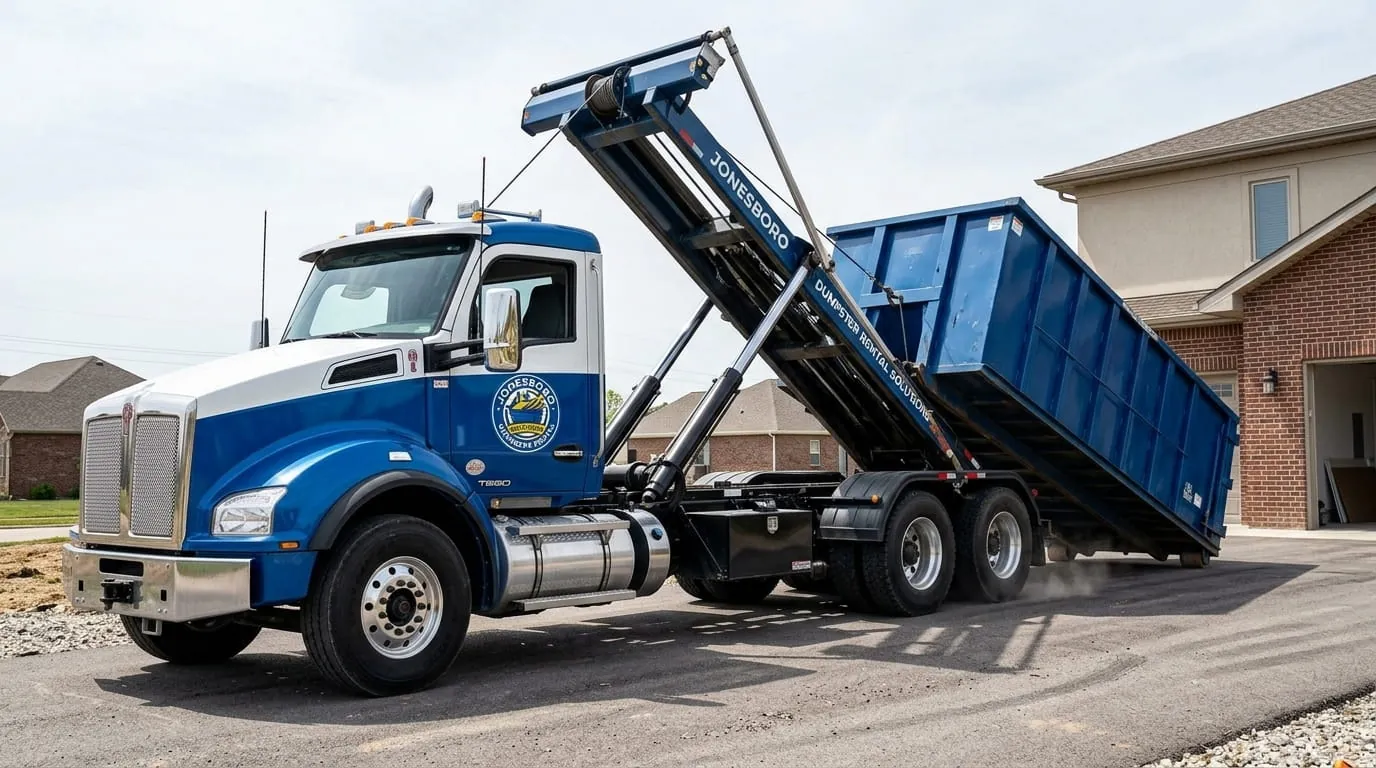
After years of dropping roll-off dumpsters on driveways, jobsites, and farm lanes all across Jonesboro and Craighead County, I can tell you the single most common question we hear is also the most important one to get right: what size dumpster do I actually need? Order too small and you're paying for a second haul or watching debris pile up beside a bin that's already full. Order too big and you're paying for empty air and eating a footprint your driveway didn't have room for. This guide walks through the four sizes we run every day, what each one really holds, the weight limits that trip people up, and how to match a bin to your specific job here in Northeast Arkansas.
The Four Roll-Off Sizes We Run in Jonesboro
Roll-off dumpsters are measured in cubic yards, which tells you the volume they hold, not the weight. Around here the four workhorse sizes are the 10, 15, 20, and 30 yard. Every one of them rolls off the back of the same style truck, and on the flat Delta lots that make up most of Jonesboro they drop clean and level with almost no fuss. The exceptions are the sloped properties up on Crowley's Ridge, where a little planning on placement goes a long way. Here's how the sizes break down.
10-Yard Dumpster
The 10-yard is our smallest and it's built for heavy, dense material. Typical dimensions run about 12 to 14 feet long, 8 feet wide, and 3.5 feet tall. It holds roughly the equivalent of three to four pickup truck loads. Because it's low and short, it's the size you want for concrete, dirt, brick, and roofing shingles, all of which get heavy fast. A 10-yard is perfect for a single-room bathroom remodel, a small concrete patio tear-out, or clearing out one of those older brick homes near downtown or over by ASU. Don't let the small size fool you: fill one with concrete and you'll hit the weight limit long before you fill the volume. Learn more on our 10-yard dumpster page.
15-Yard Dumpster
The 15-yard is the tweener size, and honestly it's one of the most useful bins we rent. Dimensions land around 14 to 16 feet long, 8 feet wide, and 4 feet tall, holding four to five pickup loads. It's the sweet spot for a mid-sized cleanout, a mid-range kitchen remodel, or a garage and attic purge that's more than a 10 can handle but doesn't justify a 20. For a lot of ASU student-rental turnovers, where you're clearing out furniture, mattresses, and a semester's worth of leftover junk, the 15 hits it right. See details on the 15-yard dumpster page.
20-Yard Dumpster
The 20-yard is our most popular size, and for good reason. It measures roughly 20 to 22 feet long, 8 feet wide, and 4.5 feet tall, and swallows six to eight pickup loads. It's the go-to for whole-room renovations, medium roof tear-offs, larger household cleanouts, and flooring or carpet jobs across a full house. If you're gutting a couple of rooms or clearing out a barn or outbuilding on a Delta farm property, the 20 gives you room to work without towering walls you have to heave debris over. Check the 20-yard dumpster page for more.
30-Yard Dumpster
The 30-yard is the big one, built for volume. It runs about 22 feet long, 8 feet wide, and 6 feet tall, holding nine to twelve pickup loads. Because the walls are taller, it's better for light and bulky material than for dense debris. It's the right call for a whole-home renovation, new-construction framing scrap and packaging, a large estate cleanout, or a major storm cleanup after one of our severe spring systems drops trees and limbs across a property. With Jonesboro growing the way it is, we drop a lot of 30-yard bins on new-construction subdivisions on the edges of town. See the 30-yard dumpster page.
Real Dimensions and What Each Size Holds
| Size | Approx. Dimensions (L x W x H) | Pickup Loads | Best For |
|---|---|---|---|
| 10 yard | 13 x 8 x 3.5 ft | 3-4 | Concrete, dirt, shingles, small baths |
| 15 yard | 15 x 8 x 4 ft | 4-5 | Mid cleanouts, kitchen remodels, garage purge |
| 20 yard | 21 x 8 x 4.5 ft | 6-8 | Whole-room reno, roof tear-off, big cleanouts |
| 30 yard | 22 x 8 x 6 ft | 9-12 | Whole-home reno, new construction, storm debris |
Weight Limits and Overage Fees: The Part People Miss
Here's where most of the surprise charges come from. Every dumpster rental includes a weight allowance measured in tons, and that allowance is separate from the volume. A 10-yard might include 1 to 2 tons, a 20-yard 3 to 4 tons, and a 30-yard 4 to 5 tons, depending on your rental terms. Go over that included tonnage and you pay an overage fee, usually charged per ton, because the landfill charges us by weight when we dump it.
Why does this matter? Because volume and weight fill up at completely different rates depending on what you're throwing away. A 20-yard bin filled with cardboard and drywall might never come close to its weight limit. That same bin half-full of concrete could blow past the tonnage cap and cost you hundreds in overage. Always ask what your included weight is, and be honest with us about what you're loading so we can steer you right the first time. We break the numbers down further in our dumpster rental cost guide for Jonesboro.
Heavy Debris: Why Concrete, Dirt, and Shingles Go in Small Bins
This is the counterintuitive rule that saves people the most money. When you're hauling dense material, you want a smaller dumpster, not a bigger one. Concrete, brick, dirt, sod, gravel, asphalt, and roofing shingles are so heavy that a 10-yard bin loaded with them can hit its weight ceiling at less than half full by volume. If you put that same concrete in a 30-yard bin and filled it to the top, the truck literally couldn't lift it and the axles couldn't legally carry it down the road.
So for heavy debris, we almost always put you in a 10 or occasionally a 15, sometimes with a dedicated concrete-only or dirt-only load so it can go to a recycler instead of the landfill. If you're doing a roof tear-off, shingles are deceptively heavy: a typical asphalt roof tear-off on a Jonesboro home usually fits a 15 or 20 by volume, but you have to watch the tonnage closely. Mixing heavy debris with light junk in the same bin is a fast way to an overage charge, so keep them separate when you can.
Matching the Size to Your Job
Rules of thumb are helpful, but the real answer depends on the job. Here's how we size the projects we see most often around Craighead County.
- Bathroom remodel (single room): A 10-yard handles the tile, vanity, tub, and drywall from one bathroom with room to spare. If it's a large master bath or you're doing two at once, step up to a 15.
- Kitchen remodel: A 15-yard is usually right for cabinets, countertops, flooring, and appliances. Go 20 if you're also opening up walls or redoing an adjacent room.
- Whole-home renovation: A 20 or 30-yard, and often more than one haul. Gutting a whole older brick home near downtown or the university generates a lot of plaster and lath, which is heavier than modern drywall, so watch the weight.
- Roof tear-off: A single-layer asphalt roof on an average home fits a 15 or 20 by volume, but shingles are heavy, so mind the tonnage. Multiple layers or a big roof may need a second bin.
- Garage or attic cleanout: A 15-yard covers most, and a 20 if decades of storage have accumulated. These are great candidates for our residential dumpster rental service.
- New construction: A 30-yard for framing scrap, packaging, offcuts, and jobsite trash. Builders on the new subdivisions ringing Jonesboro usually keep one on site the whole build. See our construction dumpster rental page.
- Barn, outbuilding, or farm cleanout: Delta farm properties often need a 20 or 30 for old equipment, lumber, and general debris. We know these lots and how to get a truck down a farm lane.
- Storm cleanup: After a severe spring storm, a 20 or 30-yard handles downed limbs, fence, and roof damage. We keep bins moving fast when the weather turns, because in our hot, humid summers that debris doesn't wait.
Placement on Jonesboro Lots
One thing that makes life easy around here: most of Jonesboro and the surrounding Delta sits on flat, open ground, so dropping a roll-off is usually straightforward. We put down boards to protect your driveway and set the bin where you want it. The main thing to plan for is clearance, because the truck needs about 60 feet of straight space to load and unload, plus overhead room free of low branches and power lines.
The exception is Crowley's Ridge, that band of higher, sloped ground running through the area. On a graded or sloped lot we take extra care with placement so the bin sits stable and the door swings clean. If you're on the Ridge, just let us know when you book and we'll plan the drop accordingly. When in doubt about access or the right size, that's exactly what our roll-off dumpster rental team is here for.
When to Size Up and When to Size Down
If your job is between two sizes on volume, size up. The price difference between, say, a 15 and a 20 is smaller than the cost of a second haul, and having a little extra room beats running out of space with debris still on the ground. But if your job is heavy, dense material, size down and watch the weight instead. That single distinction, volume jobs versus weight jobs, is the thing that keeps your rental predictable and your bill free of surprises.
Still not sure? That's genuinely the most common reason people call us, and there's no wrong question. Tell us the project and we'll tell you the size. You can reach our team any time at (870) 604-3848 or through our contact page, and we'll get the right bin on your driveway fast. Get the size right the first time and the whole project goes smoother.

Owner, Jonesboro Dumpster Rental Solutions — sharing straight advice from years of local hauling across Jonesboro and Craighead County.
Frequently Asked Questions
What is the most common dumpster size for a home project in Jonesboro?
The 20-yard is our most popular size for homeowners. It handles whole-room renovations, larger cleanouts, medium roof tear-offs, and flooring jobs, holding roughly six to eight pickup loads. For smaller single-room jobs a 10 or 15-yard is often plenty, and we're happy to help you pick over the phone.
Why do you put concrete and dirt in a small dumpster instead of a big one?
Concrete, dirt, brick, and shingles are extremely heavy, so a small 10-yard bin hits its weight limit long before it fills up by volume. A large bin loaded with concrete would be too heavy for the truck to lift and haul legally. For dense debris, a smaller bin keeps you under the tonnage cap and avoids overage fees.
What happens if I go over the weight limit on my dumpster?
Every rental includes a set weight allowance in tons. If your load exceeds it, you pay an overage fee charged per additional ton, because the landfill charges us by weight. To avoid surprises, tell us what you're throwing away up front so we can size the bin and estimate the tonnage correctly the first time.
Can you place a dumpster on a sloped lot on Crowley's Ridge?
Yes. Most Jonesboro and Delta lots are flat and easy, but Crowley's Ridge has sloped ground that needs extra care. Just tell us when you book that you're on a graded or sloped property, and we'll plan the placement so the bin sits stable and the door swings clean.
What size dumpster do I need for a roof tear-off?
A single-layer asphalt roof on an average Jonesboro home usually fits a 15 or 20-yard bin by volume. The catch is that shingles are heavy, so we watch the weight limit closely. Multiple layers or a large roof may need a second haul. Call us with your roof's square footage and layer count and we'll size it right.